
In this article, we’ll cover what insecure deserialization is and evaluate the consequences of blindly trusting any user-supplied input into the application and understand how a potential attacker can utilize this weakness in launching a further attack. Let’s dive into the ins and outs of insecure deserialization vulnerabilities.
What is (de)serialization?
The main purpose of performing serialization and deserialization of any object is simple. Computers or network infrastructures don’t understand language or numbers the way humans do. Everything on a computer is represented as streams of binary numbers or bytes that the computer can easily understand, process or store.
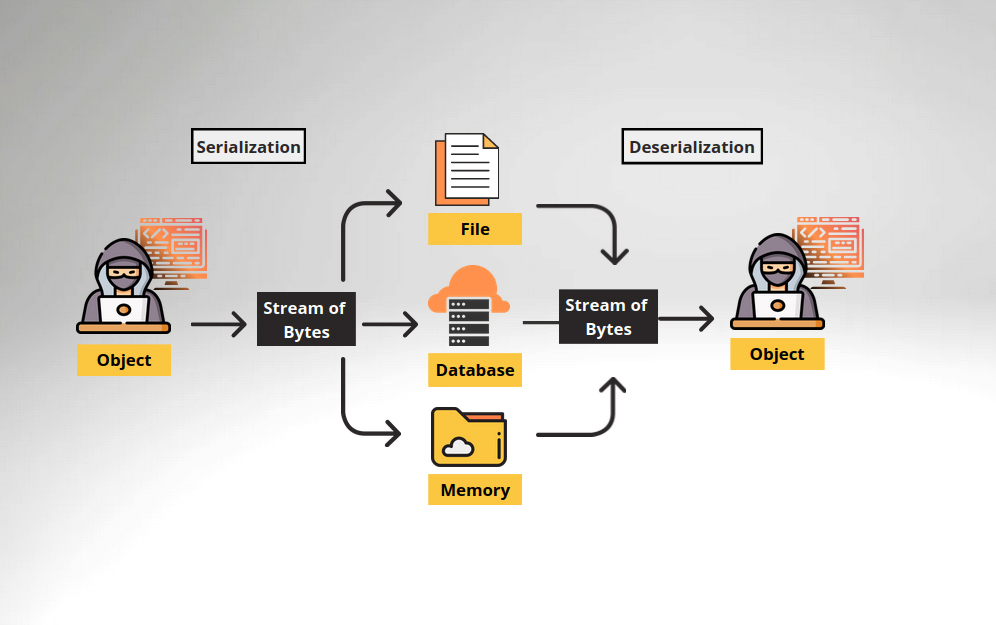
Serialization is the process of converting an object into a stream of bytes to store the object or transmit it to memory, a database, or transfer over a network. It also allows the object to be recreated when needed.
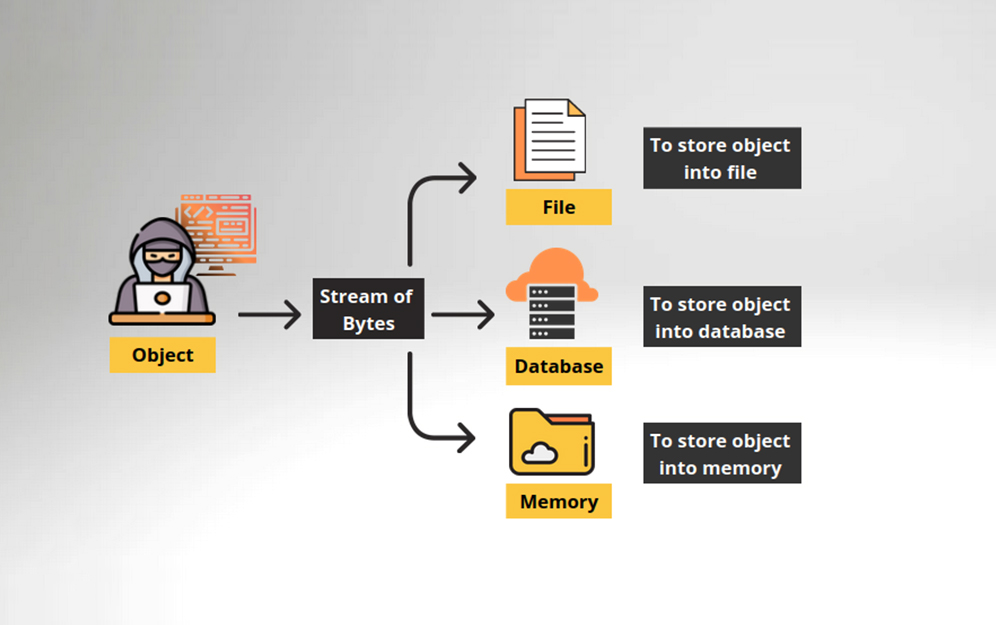
Deserialization is the opposite. It is the process of reconstructing the object from the serialized state. It is the reverse operation of serialization where the stream of bytes is converted into a form of an object.
What causes insecure deserialization?
The root cause of an insecure deserialization vulnerability mainly arises in the fact that developers consider that the deserialized objects are often to be trustworthy and trust the data provided by a sanitized object more than classical user input. By assuming that users cannot read or manipulate the serialized data effectively, it is directly passed into the functions without verification.
When a software deserializes user-controlled data without any verification or validation, this potentially enables an attacker to manipulate serialized objects to pass malicious content into the application code or the vulnerable server.
If the deserialization process is not adequately secured, attackers can exploit it to inject a malicious serialized object into an application and can perform different kinds of malicious attacks, such as Code Injection, SQL Injection, Path Traversal, and Application Denial of Service, depending on the context. Attackers can use insecure deserialization as an entry point to a system, from which they can pivot to further attacks.
User-provided data such as URL parameters, POST data payloads, or cookies should always be considered untrusted and tainted.
To understand the vulnerability further, let’s take a look at how serialization and deserialization work in PHP and Python.
Insecure Deserialization in PHP
Below is an example of serialization in PHP.
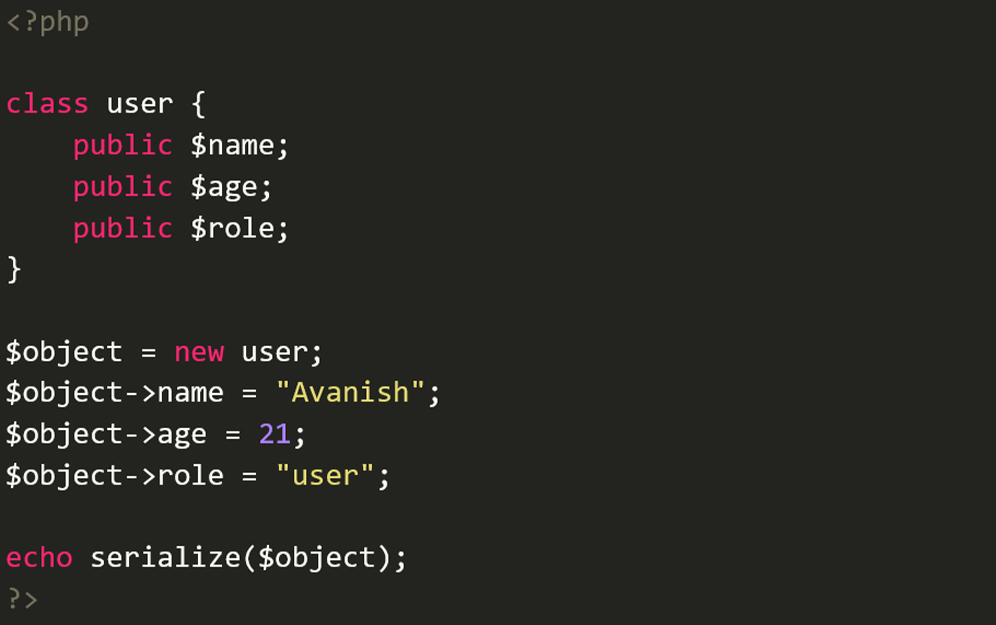
The serialize() function generates a storable representation of a value so that it can be stored in a file, a memory buffer, or transmitted across a network.
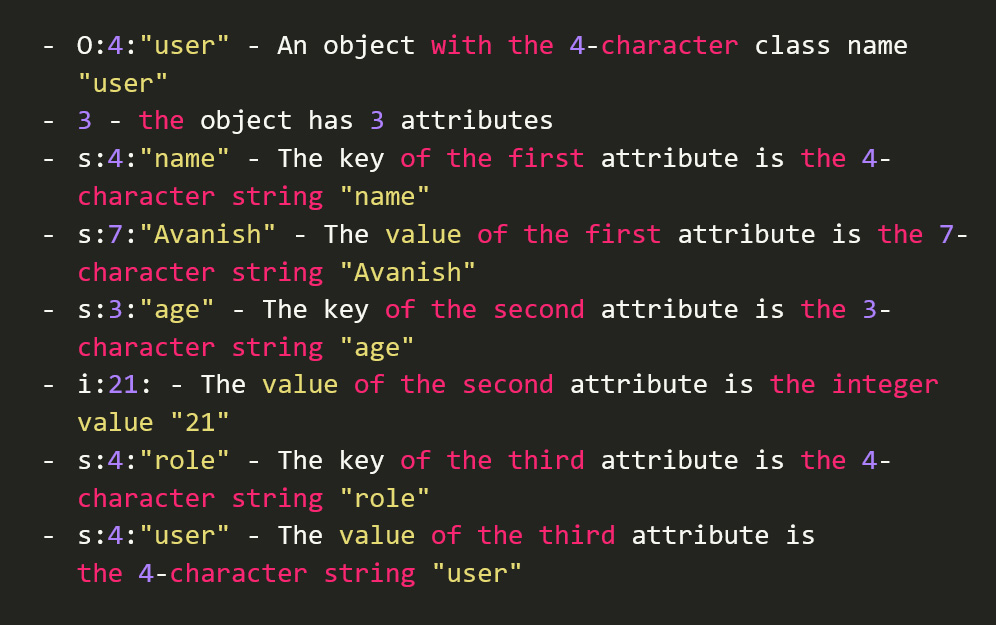
PHP will serialize data in a mostly human-readable format which can be seen below.
The following serialized data can be interpreted as follows:
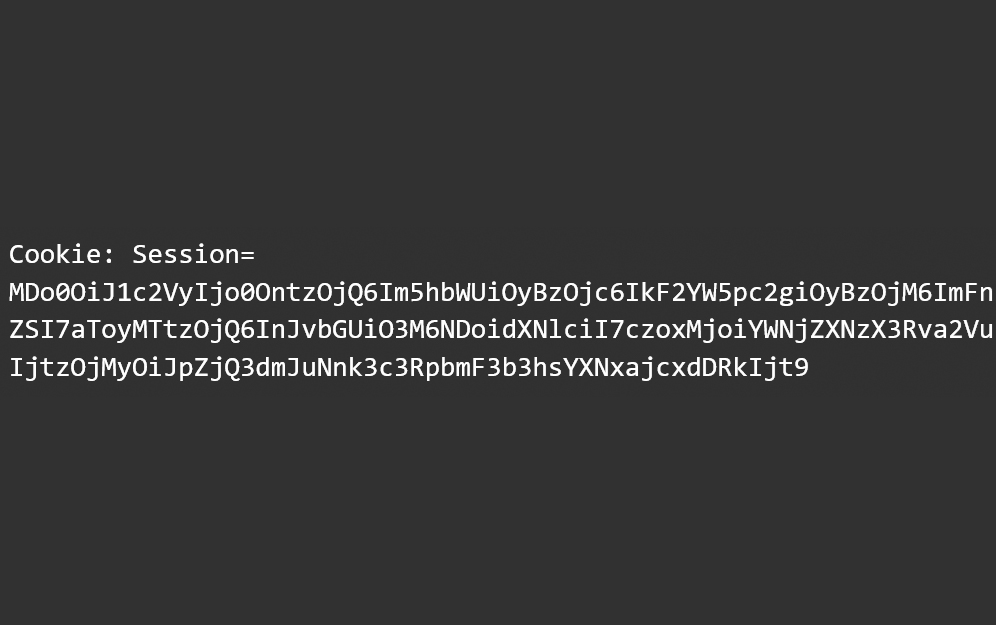
As a simple example, if an attacker spotted this serialized object in an HTTP request as a form of a session cookie as shown below:
They might decode it to find the following byte stream:
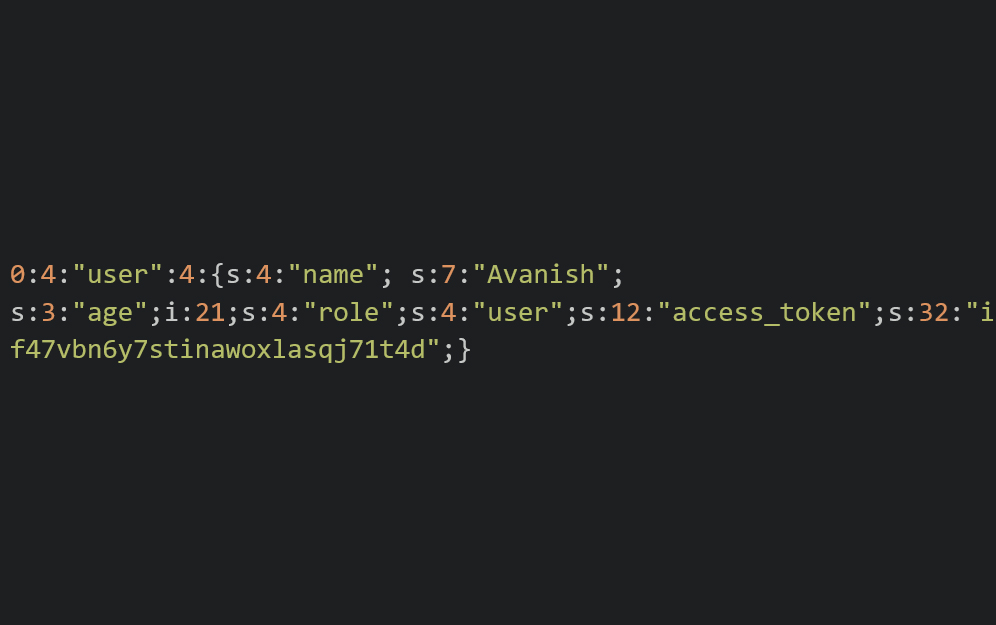
Let’s say the website relies on this session cookie to check the user role of the logged-in user. A malicious attacker could easily manipulate the value of the “role” parameter to “admin” or any higher privilege user and at no point is the authenticity of the serialized object checked. This data is then passed into the conditional statement and, as the application depends upon the serialized object to determine the user role, the attacker could efficiently escalate the privilege which would allow for an easy privilege escalation.
Insecure Deserialization in Python
The Python pickle module allows you to serialize and deserialize data. Essentially, this means that you can convert a Python object into a stream of bytes and then reconstruct it later in a different process or environment by loading that stream of bytes.
Since there are no effective ways to verify the pickle stream being unpickled, it is possible to provide malicious shell code as input, causing remote code execution and other critical vulnerabilities.
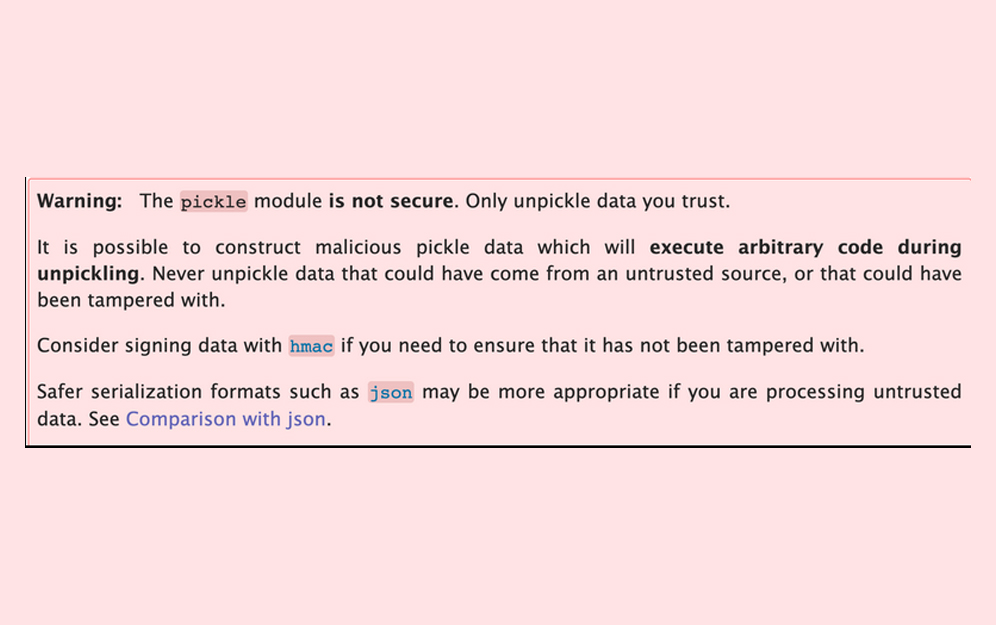
While referring to the Python docs for pickle one cannot miss the following warning:
➔ Warning: The pickle module is not secure. Only unpickle data you trust.