
APIs have evolved, and so have the attacks targeting them.
GraphQL, the modern query language designed for efficiency and flexibility, is rapidly replacing REST across industries. But with that flexibility comes a hidden cost: security blind spots that many organizations overlook.
Unlike traditional REST APIs with fixed endpoints, GraphQL gives clients the freedom to query exactly what they need, and attackers, the freedom to ask for a lot more. From introspection leaks and injection attacks to denial-of-service (DoS) via complex queries, GraphQL’s design can quickly turn from powerful to perilous if left unchecked.
In this blog, you will learn:
- How attackers exploit GraphQL APIs
- Common vulnerabilities (with real-world examples)
- Best practices to lock down your GraphQL API in production
Because when it comes to GraphQL, what you don’t lock down could be what brings your system down.
What makes GraphQL different (and risky)?
GraphQL vulnerabilities generally arise due to implementation and design flaws. Unlike REST APIs that expose fixed endpoints, GraphQL allows clients to query exactly what they need in a single request.
GraphQL’s dynamic querying model:
- Exposes a *single entry point* (`/graphql`) for all operations
- Encourages *deep nesting* and *recursive queries*
- Often enables *introspection*, giving attackers a map of the API schema
These features increase developer productivity—but they also give attackers a lot to work with.
Why it matters: GraphQL is powerful and flexible, but that flexibility can be a double-edged sword. While it helps avoid common REST issues like over-fetching, it also introduces new attack vectors that aren’t fully addressed by the OWASP API Top 10.
Understanding GraphQL: A developer’s API language
GraphQL is a query language for APIs, developed by Facebook and open-sourced in 2015. Unlike REST, it enables you to request only the data you need, in the structure you desire.
Examples of GraphQL endpoints
A GraphQL endpoint is usually a single HTTP endpoint (e.g., /graphql) that accepts POST or GET requests. It’s impractical to list all permutations of endpoints associated with a GraphQL instance. However, many GraphQL APIs, especially those built with frameworks like Apollo, commonly use standard endpoint paths such as:
/v1/explorer
/v1/graphiql
/graph
/graphql
/graphql/console/
/graphql.php
/graphiql
/graphiql.php
(…) A comprehensive list can be found on https://github.com/danielmiessler/SecLists/blob/master/Discovery/Web-Content/graphql.txt.
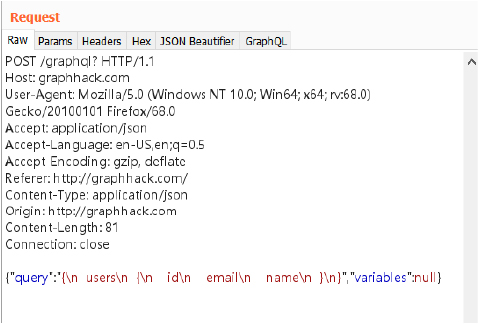
Sample GraphQL Request
Red flags that reveal a GraphQL endpoint
- Response includes “errors”: […]
- MIME type is application/json with GraphQL structure
- Developer tools show introspection queries or GraphQL-specific headers like X-GraphQL-Operation-Name or Apollo-Require-Preflight
- Accessing URLs like /graphiql, /graphql-playground, or /altair brings up an interactive explorer.
- The server responds to introspection queries like __schema or __type.
- JS files contain fetch or Apollo client code referencing /graphql or similar.
Another effective method to identify hidden GraphQL endpoints involves searching JavaScript files for keywords like “query”, “mutation”, or “graphql”. This can reveal unofficial or decommissioned GraphQL endpoints.
Top GraphQL attack vectors you need to know:
1. Information disclosure
GraphQL’s introspection feature allows clients to query the schema, which is useful for development but risky in production.
2. Injection attacks (SQL, NoSQL, Logging)
GraphQL queries are structured, but the parameters they carry can still be used for injection attacks—especially SQL injections—if resolvers pass user input directly to a database.
3. Denial of Service (DoS) via complex queries
GraphQL allows nested queries, which can lead to denial-of-service (DoS) attacks through overly complex or deeply nested queries.
4. Authorization bypass
Unlike REST, where authorization can be applied per endpoint, GraphQL operates on a single endpoint. This requires fine-grained, field-level authorization, which is often overlooked. GraphQL doesn’t enforce authorization by default.
5. Insecure defaults in popular libraries
Many GraphQL server implementations ship with insecure default configurations that can expose applications to serious risks if left unchanged (e.g., Apollo Server’s tracing and debug modes).
6. GraphQL CSRF
GraphQL can be used as a vector for CSRF attacks, whereby an attacker creates an exploit that causes a victim’s browser to send a malicious query as the victim user. Let’s understand this more with an Exploit POC:
Scenario: Updating a user’s email via CSRF
Assume the GraphQL mutation looks like this:
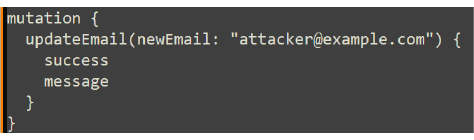
And it’s accessible via a POST request to:
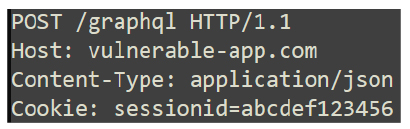
It is assumed that,
- Accepts application/json POST from any origin
- No CSRF token or origin check
- Victim is logged in and has a valid session.
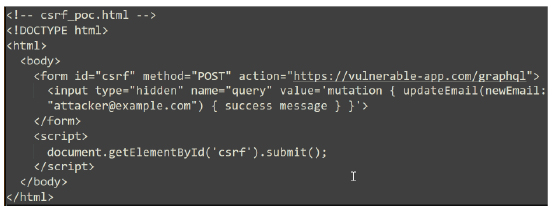
Malicious HTML POC
If the server strictly enforces application/json, CSRF via browser is harder. But we can bypass this with a Custom Request (Using JavaScript + JSON) but only if CORS misconfiguration allows application/json cross-origin requests
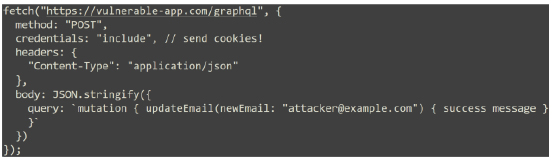
Bypass with a custom request
Mitigations
- Enforce CSRF tokens for state-changing operations.
- Require proper CORS settings: disallow cross-origin credentials.
- Reject non-application/json or non-XHR requests for mutations.
- Validate Origin and Referer headers
7. Alias overloading
Here the attackers overload a query with many aliases for the same field, causing the backend resolver to execute that field repeatedly. This can overwhelm server resources, leading to a Denial of Service (DoS), amplify the impact of a query, or extract more data than intended.
This can be Defended with query cost analysis & alias limits – block queries with repetitive fields under different aliases to prevent data extraction/DoS.
Beyond OWASP API Top 10: Unique GraphQL threats
While OWASP API Top 10 covers high-level risks (like Broken Object Level Authorization and Excessive Data Exposure), GraphQL introduces new layers that require additional scrutiny:
| OWASP Category | GraphQL Amplification |
| API1:2019 – BOLA | Needs per-field authorization checks |
| API3:2019 – Excessive Data Exposure | Exposed through flexible querying |
| API4:2019 – Lack of Resources & Rate Limiting | Exploited via deep/complex queries |
| API7:2019 – Security Misconfiguration | Introspection and default settings |
GraphQL Security Arsenal: Tools for offense and defense
Testing tools significantly simplify GraphQL testing by visualising schemas and automating common tasks. Below are particularly useful tools for pentesting GraphQL vulnerabilities more efficiently:
- InQL (Burp Suite Plugin): It allows you to perform introspection queries and generate query templates based on discovered schemas. It also has multiple methods for schema discovery that are useful to leverage where introspection is disabled. https://github.com/doyensec/inql
- GraphQLmap: Inspired by SQLmap, this Python-based tool automates common GraphQL attack techniques. https://github.com/swisskyrepo/GraphQLmap
- GraphQL Raider (Burp Extension): Developed by PortSwigger researchers, GraphQL Raider allows hands-on fuzzing and token manipulation via Burp. https://portswigger.net/bappstore/4841f0d78a554ca381c65b26d48207e6
- Escape’s GraphQL Security Scanner: Escape Technologies provides a SaaS-based GraphQL scanner designed for CI/CD pipelines. https://escape.tech
- GraphBreaker: A tool from security research communities that focuses on fuzzing and breaking introspection in misconfigured GraphQL APIs. https://github.com/EdOverflow/graphbreaker
- Clairvoyance: It is a tool that uses suggestions to automatically recover all or part of a GraphQL schema, even when introspection is disabled. This makes it significantly less time consuming to piece together information from suggestion responses https://github.com/nikitastupin/clairvoyance
GraphQL security implementation strategy for organizations
When deploying GraphQL at scale, organizations must move beyond surface-level best practices and treat GraphQL as a core application surface that needs structured risk management. Here’s how to do that effectively:
Establish an API governance model
- Define who owns the GraphQL schema (e.g., API team, product teams).
- Enforce schema review processes before deployment (automated via CI/CD).
- Use API contracts to separate internal vs. external schema exposure.
Centralize authentication and authorization logic
- Don’t rely on resolvers alone for access control.
- Use gateway-level enforcement (e.g., with API Gateway or BFF layer).
- Create a central auth service to handle user identity, roles, scopes.
- Standardize access control using libraries like graphql-shield or custom directives.
Use a GraphQL gateway or API firewall
Deploy a GraphQL gateway like Apollo Router or Hasura with:
- Query cost analysis
- Depth/complexity limiting
- IP/user rate limiting
- Persisted query support
Automate security testing in CI/CD
Run automated tests for:
- Authorization bypasses (e.g., over-fetching private fields)
- Excessive query depth or cost
- Introspection exposure
- Use tools like GraphQL-CSRF-checker, GraphQL Security Scanner, DAST tools like StackHawk or escape.tech
Security testing
- Pentest GraphQL APIs (test for alias overloading, injection, auth flaws).
Log, monitor and trace every query
- Log metadata: Query hash, User ID, Response time, Error types
- Use distributed tracing (e.g., OpenTelemetry + GraphQL plugins) to spot performance hotspots or abuse patterns.
- Adopt defense-in-depth—combine query analysis, auth controls, and monitoring to secure GraphQL at every layer.
Pro tip: Don’t wait for a breach to harden your API.
Start with visibility: audit your schema, know what’s exposed, and test like an attacker would. If you’re not threat modeling your GraphQL surface, someone else probably is.
By proactively managing exposure, validating inputs, and enforcing strict authorization, by understanding these vulnerabilities and applying best practices, you can build robust and secure GraphQL APIs.
Security best practices for securing GraphQL APIs
- Disable unused fields and types in your schema.
- Use linting and validation tools to enforce security practices during development.
- Regularly audit your schema and resolvers for exposure or logic flaws.
- Implement logging and monitoring to detect unusual behaviour or access patterns.
- Keep third-party libraries up to date and stay informed about known vulnerabilities.
- Disable introspection in production.
- Whitelist queries** in sensitive environments.
- Limit query depth/complexity to prevent DoS.
- Enforce strict authorization per resolver.
- Validate and sanitize all inputs.
- Use rate limiting to prevent abuse.
- Secure transport (HTTPS, avoid exposing errors).
Conclusion: The future of API development with GraphQL
As the demand for faster, more flexible, and efficient APIs grows, GraphQL stands out as a transformative technology. GraphQL provides powerful tools for API design, but its flexibility also introduces new attack surfaces. Developers must adopt a security-first mindset and apply the same rigor to GraphQL that they would to any other API technology.
GraphQL isn’t insecure by design—but it does require a different approach to API security. Its flexibility is both a feature and a vulnerability.
Looking ahead, the future of API development is increasingly client-driven, schema-first, and performance-focused—all of which align perfectly with GraphQL’s design philosophy. As usage grows, we need to treat GraphQL with the same attention we give to OWASP risks—if not more.
Ready to strengthen your GraphQL defenses? Get in touch to design secure, high-performance APIs built for the modern attack landscape.
References
https://cheatsheetseries.owasp.org/cheatsheets/GraphQL_Cheat_Sheet.html
https://www.yeswehack.com/learn-bug-bounty/hacking-graphql-endpoints
https://labs.detectify.com/crowdsource-community/graphql-abuse-bypass-account-level-permissions-through-parameter-smuggling/
https://github.com/m14r41/PentestingEverything/tree/main/API%20Pentesting/GraphQL
https://github.com/swisskyrepo/PayloadsAllTheThings/tree/master/GraphQL%20Injection